Fibroadenoma Excision What is Fibroadenoma Excision? Fibroadenoma excision is a surgical procedure to remove fibroadenomas—benign …
Sentinel Lymph Node Biopsy (SLNB) is a minimally invasive surgical procedure used to check whether cancer has spread from its original site to the lymph nodes. It is most commonly performed for breast cancer and melanoma, but can also be applied to other cancers.
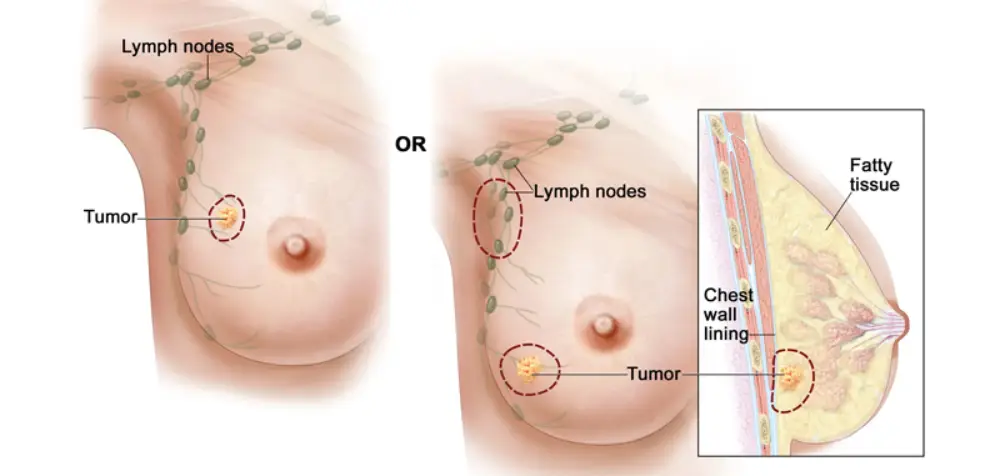
The procedure targets the sentinel lymph node—the first node that cancer cells are likely to spread to from the primary tumor. If this node is free of cancer, further lymph node removal may not be necessary. This makes SLNB an important diagnostic step that helps guide treatment decisions while reducing the need for more extensive surgeries.
SLNB is performed to evaluate the extent of cancer spread (metastasis) through the lymphatic system. Lymph nodes act as filters, trapping harmful substances such as bacteria and cancer cells. Detecting cancer in the sentinel node provides vital information for cancer staging and treatment planning.
Common reasons for SLNB include:
Breast Cancer: To check if cancer has spread beyond the breast tissue, helping to avoid more invasive procedures like axillary lymph node dissection (ALND) when unnecessary.
Melanoma: To determine whether skin cancer has spread to nearby lymph nodes.
Other Cancers: In some cases, SLNB may also be used for head and neck cancers, gynecological cancers, and others.
Presence of a lump or mass in the breast
Changes in breast size, shape, or appearance
Persistent breast pain or tenderness
Unexplained nipple discharge or nipple inversion
A new or unusual mole or skin growth
Changes in the size, shape, or color of an existing mole
Itchy, bleeding, or ulcerated skin lesions
When such symptoms are present, SLNB helps determine whether cancer has spread to the lymph nodes and if additional treatment is necessary.
During the procedure:
A radioactive tracer and/or blue dye is injected near the tumor site.
These substances travel to the sentinel lymph node(s), helping the surgeon identify them.
The identified lymph node(s) are carefully removed through a small incision.
The samples are then examined under a microscope to check for cancer cells.
If no cancer is detected, further lymph node removal is usually unnecessary. If cancer cells are present, additional treatments may include surgery, chemotherapy, radiation therapy, or targeted therapies.
SLNB is generally safe, but as with any surgical procedure, there may be risks:
Mild pain or bruising at the incision site
Temporary swelling or stiffness in the arm (for breast cancer cases)
Allergic reaction to the dye (rare)
Infection or bleeding at the biopsy site
Low risk of lymphedema (much lower compared to ALND)
Q1. How is SLNB different from axillary lymph node dissection (ALND)?
SLNB removes only a few key lymph nodes (sentinel nodes), whereas ALND removes many lymph nodes. SLNB is less invasive and carries fewer risks of complications such as lymphedema.
Q2. Is SLNB done under local or general anesthesia?
It is usually performed under general anesthesia, but in some cases, local anesthesia may be used.
Q3. How long is the recovery after SLNB?
Most patients can return to normal activities within a few days, although some mild discomfort or swelling may persist for a short time.
Q4. If cancer is found in the sentinel lymph node, what’s next?
Your doctor may recommend additional surgery (such as ALND) or systemic treatments like chemotherapy, radiation, or hormone therapy depending on the cancer type and stage.
Q5. Can SLNB be avoided?
In some very early-stage cancers, SLNB may not be necessary. Your doctor will evaluate your case and recommend the best approach.
Fibroadenoma Excision What is Fibroadenoma Excision? Fibroadenoma excision is a surgical procedure to remove fibroadenomas—benign …
Breast Cysts Excision What is Breast Cyst Excision? Breast cyst excision is a surgical procedure …
Simple Mastectomy What is a Simple Mastectomy? A simple mastectomy, also called a total mastectomy, …
Breast Conservation Surgery What is Breast Conservation Surgery? Breast Conservation Surgery (BCS), also known as …
Jupiter Hospital, Thane
Service Rd, Eastern Express Hwy, next to Viviana Mall, Thane, Maharashtra 400601, India
KIMS Hospitals, Thane
Hiranandani Estate Queens Street, Ghodbunder Rd, opposite BRENTFORD, Patlipada, Thane West, Maharashtra 400607, India
Kaushalya Medical Foundation Trust Hospital. Thane
Ganeshwadi, behind Nitin Company, Panch Pakhdi, Thane, Maharashtra 400601, India
Horizon Prime Hospital, Thane
Vibgyor, Ghodbunder Rd, near Hiranandani Estate, behind Ritu Nissan Showroom, B Wing, Patlipada, Thane West, Thane, Maharashtra 400607, India
Tieten Medicity Hospital, Thane
Ghodbunder Rd, Kasarvadavali, Thane West, Thane, Maharashtra 400615, India
Currare Hospital, Thane
GHC Hospitals. Kalwa
Shil Road, Kausa, Mumbra, Thane, Maharashtra 400612, India
Bilal Hospital & ICU. Kalwa
1st Floor, A, Wing Royal Garden, Old, Mumbai – Pune Rd, near Shimla Park, Shimla Park, Kausa, Mumbra, Thane, Maharashtra 400612, India

At Dr. Ritika Bhandari’s Breast Health Clinic, we provide advanced, compassionate, and personalized care for all breast-related concerns. As a Breast Cancer Surgeon in Thane, Dr. Ritika Bhandari offers expert guidance for breast cancer diagnosis, treatment, and surgical care.