Breast Cysts Excision What is Breast Cyst Excision? Breast cyst excision is a surgical procedure …
Fibroadenoma excision is a surgical procedure to remove fibroadenomas—benign (non-cancerous) breast lumps commonly found in younger women, especially during their late teens and twenties. While these lumps are usually painless and harmless, some women may choose or require removal for medical, cosmetic, or personal reasons.
The exact cause of fibroadenomas is not fully understood, but several factors may contribute:
Hormonal changes – Estrogen plays a major role in breast tissue growth, which may trigger fibroadenoma development during puberty, pregnancy, or hormone therapy.
Genetic predisposition – A family history of breast lumps or benign breast conditions may increase the risk.
Hormone therapy or contraceptives – These may encourage growth of existing fibroadenomas but rarely cause new ones to form.
Most fibroadenomas are painless, but they often present with:
Smooth, rubbery, or firm breast lumps that move easily under the skin
Round or oval-shaped lumps of varying sizes
Multiple fibroadenomas in one or both breasts (in some women)
Mild tenderness during menstrual cycles due to hormonal fluctuations
Large fibroadenomas that may cause visible asymmetry or discomfort
Not every fibroadenoma requires surgery. Excision may be recommended if:
The lump is large or rapidly growing
There is discomfort, pain, or cosmetic concern
Biopsy results are unclear, or atypical cells are detected
The patient has a strong family history of breast cancer
Outpatient surgery – Usually performed under local or general anesthesia
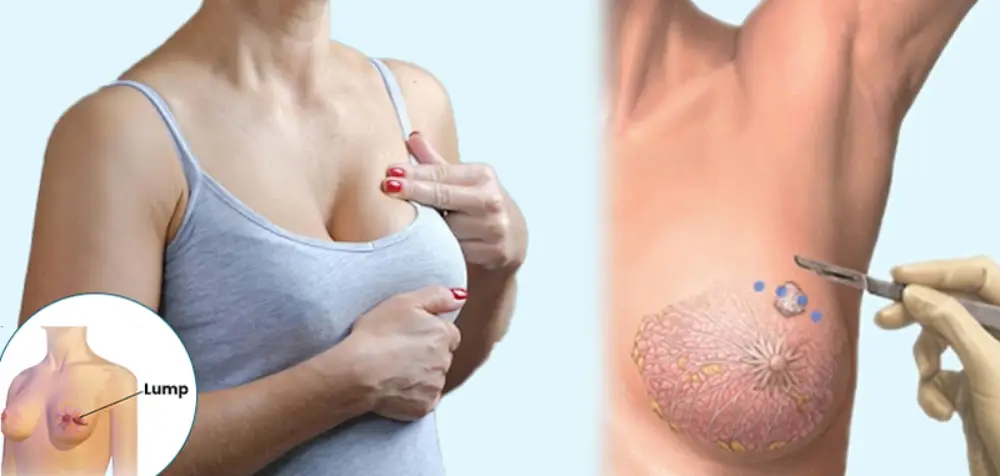
Small incision – Made near the lump to carefully remove the fibroadenoma
Histopathology – The excised tissue is tested to confirm it is benign
Recovery – Patients typically recover within a few days, experiencing only mild discomfort, swelling, or bruising
Minimal scarring – A small scar may remain, but cosmetic outcomes are usually excellent
Normal activities can usually be resumed within a few days
Pain or swelling is mild and manageable with medications
Follow-up appointments ensure proper healing and peace of mind
1. Is fibroadenoma excision painful?
The procedure is performed under anesthesia, so patients do not feel pain during surgery. Mild discomfort may occur afterward, but it typically resolves within a few days.
2. Can fibroadenomas come back after removal?
Yes, new fibroadenomas can develop, but the excised one does not return. Regular breast check-ups are recommended.
3. Will surgery leave a scar?
A small scar may remain at the incision site, but surgeons use techniques to minimize scarring for better cosmetic results.
4. Is removal necessary for all fibroadenomas?
No, small, stable, and non-symptomatic fibroadenomas may only require observation and regular monitoring.
5. How long does recovery take?
Most patients recover within 3–7 days, with minimal restrictions on daily activities.
Breast Cysts Excision What is Breast Cyst Excision? Breast cyst excision is a surgical procedure …
Simple Mastectomy What is a Simple Mastectomy? A simple mastectomy, also called a total mastectomy, …
Breast Conservation Surgery What is Breast Conservation Surgery? Breast Conservation Surgery (BCS), also known as …
Modified Radical Mastectomy What is a Modified Radical Mastectomy? A Modified Radical Mastectomy (MRM) is …
Jupiter Hospital, Thane
Service Rd, Eastern Express Hwy, next to Viviana Mall, Thane, Maharashtra 400601, India
KIMS Hospitals, Thane
Hiranandani Estate Queens Street, Ghodbunder Rd, opposite BRENTFORD, Patlipada, Thane West, Maharashtra 400607, India
Kaushalya Medical Foundation Trust Hospital. Thane
Ganeshwadi, behind Nitin Company, Panch Pakhdi, Thane, Maharashtra 400601, India
Horizon Prime Hospital, Thane
Vibgyor, Ghodbunder Rd, near Hiranandani Estate, behind Ritu Nissan Showroom, B Wing, Patlipada, Thane West, Thane, Maharashtra 400607, India
Tieten Medicity Hospital, Thane
Ghodbunder Rd, Kasarvadavali, Thane West, Thane, Maharashtra 400615, India
Currare Hospital, Thane
GHC Hospitals. Kalwa
Shil Road, Kausa, Mumbra, Thane, Maharashtra 400612, India
Bilal Hospital & ICU. Kalwa
1st Floor, A, Wing Royal Garden, Old, Mumbai – Pune Rd, near Shimla Park, Shimla Park, Kausa, Mumbra, Thane, Maharashtra 400612, India

At Dr. Ritika Bhandari’s Breast Health Clinic, we provide advanced, compassionate, and personalized care for all breast-related concerns. As a Breast Cancer Surgeon in Thane, Dr. Ritika Bhandari offers expert guidance for breast cancer diagnosis, treatment, and surgical care.